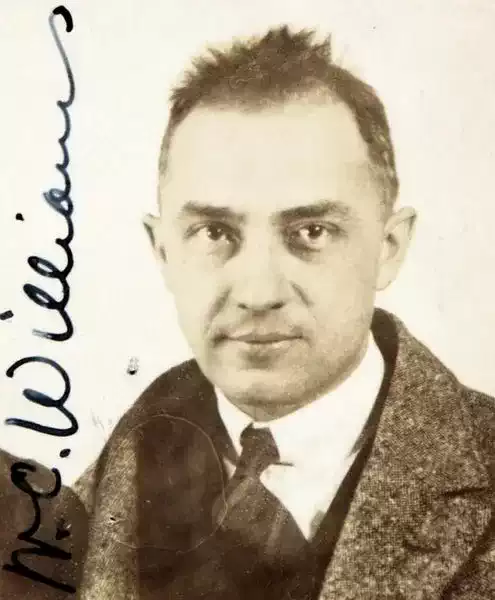
Poems List

I have discovered that most of the beauties of travel are due to the strange hours we keep to see them.

January Morning [1917], sec. 1

1

I walk back streets admiring the houses of the very poor.

Pastoral [1917]

1

Who shall say I am not the happy genius of my household?

Danse Russe [1917]

4

No wreaths please— especially no hothouse flowers. Some common memento is better, something he prized and is known by: his old clothes—a few books perhaps.

Tract [1917]

Poke around.
1

Tract

Tract
I will teach you my townspeople
how to perform a funeral
for you have it over a troop
of artistsunless
one should scour the worldyou
have the ground sense necessary.
See! the hearse leads.
I begin with a design for a hearse.
For Christ's sake not blacknor
white either - and not polished!
Let it be whethered - like a farm wagon -
with gilt wheels (this could be
applied fresh at small expense)
or no wheels at all:
a rough dray to drag over the ground.
Knock the glass out!
My God - glass, my townspeople!
For what purpose? Is it for the dead
to look out or for us to see
the flowers or the lack of them -
or what?
To keep the rain and snow from him?
He will have a heavier rain soon:
pebbles and dirt and what not.
Let there be no glass -
and no upholstery, phew!
and no little brass rollers
and small easy wheels on the bottom -
my townspeople, what are you thinking of?
A rough plain hearse then
with gilt wheels and no top at all.
On this the coffin lies
by its own weight.
No wreathes pleaseespecially
no hot house flowers.
Some common memento is better,
something he prized and is known by:
his old clothes - a few books perhaps -
God knows what! You realize
how we are about these things
my townspeople -
something will be found - anything
even flowers if he had come to that.
So much for the hearse.
For heaven's sake though see to the driver!
Take off the silk hat! In fact
that's no place at all for him -
up there unceremoniously


dragging our friend out to his own dignity!
Bring him down - bring him down!
Low and inconspicuous! I'd not have him ride
on the wagon at all - damn him! -
the undertaker's understrapper!
Let him hold the reins
and walk at the side
and inconspicuously too!
Then briefly as to yourselves:
Walk behind - as they do in France,
seventh class, or if you ride
Hell take curtains! Go with some show
of inconvenience; sit openly -
to the weather as to grief.
Or do you think you can shut grief in?
What - from us? We who have perhaps
nothing to lose? Share with us
share with us - it will be money
in your pockets.
Go now
I think you are ready.
443

Willow Poem

Willow Poem
It is a willow when summer is over,
a willow by the river
from which no leaf has fallen nor
bitten by the sun
turned orange or crimson.
The leaves cling and grow paler,
swing and grow paler
over the swirling waters of the river
as if loth to let go,
they are so cool, so drunk with
the swirl of the wind and of the river --
oblivious to winter,
the last to let go and fall
into the water and on the ground.
415

To a Friend Concerning Several Ladies

To a Friend Concerning Several Ladies
You know there is not much
that I desire, a few chrysanthemums
half lying on the grass, yellow
and brown and white, the
talk of a few people, the trees,
an expanse of dried leaves perhaps
with ditches among them.
But there comes
between me and these things
a letter
or even a look--well placed,
you understand,
so that I am confused, twisted
four ways and--left flat,
unable to lift the food to
my own mouth:
Here is what they say: Come!
and come! and come! And if
I do not go I remain stale to
myself and if I go--
I have watched
the city from a distance at night
and wondered why I wrote no poem.
Come! yes,
the city is ablaze for you
and you stand and look at it.
And they are right. There is
no good in the world except out of
a woman and certain women alone
for certain. But what if
I arrive like a turtle,
with my house on my back or
a fish ogling from under water?
It will not do. I must be
steaming with love, colored
like a flamingo. For what?
To have legs and a silly head
and to smell, pah! like a flamingo
that soils its own feathers behind.
Must I go home filled
with a bad poem?
And they say:
Who can answer these things
till he has tried? Your eyes
are half closed, you are a child,
oh, a sweet one, ready to play
but I will make a man of you and
with love on his shoulder--!
And in the marshes


the crickets run
on the sunny dike's top and
make burrows there, the water
reflects the reeds and the reeds
move on their stalks and rattle drily.
400

To Elsie

To Elsie
The pure products of America
go crazy--
mountain folk from Kentucky
or the ribbed north end of
Jersey
with its isolate lakes and
valleys, its deaf-mutes, thieves
old names
and promiscuity between
devil-may-care men who have taken
to railroading
out of sheer lust of adventure--
and young slatterns, bathed
in filth
from Monday to Saturday
to be tricked out that night
with gauds
from imaginations which have no
peasant traditions to give them
character
but flutter and flaunt
sheer rags-succumbing without
emotion
save numbed terror
under some hedge of choke-cherry
or viburnumwhich
they cannot express--
Unless it be that marriage
perhaps
with a dash of Indian blood
will throw up a girl so desolate
so hemmed round
with disease or murder
that she'll be rescued by an
agent--
reared by the state and
sent out at fifteen to work in
some hard-pressed
house in the suburbs--


some doctor's family, some Elsie--
voluptuous water
expressing with broken
brain the truth about us--
her great
ungainly hips and flopping breasts
addressed to cheap
jewelry
and rich young men with fine eyes
as if the earth under our feet
were
an excrement of some sky
and we degraded prisoners
destined
to hunger until we eat filth
while the imagination strains
after deer
going by fields of goldenrod in
the stifling heat of September
Somehow
it seems to destroy us
It is only in isolate flecks that
something
is given off
No one
to witness
and adjust, no one to drive the car
424

The Young Housewife

The Young Housewife
At ten AM the young housewife
moves about in negligee behind
the wooden walls of her husband’s house.
I pass solitary in my car.
Then again she comes to the curb
to call the ice-man, fish-man, and stands
shy, uncorseted, tucking in
stray ends of hair, and I compare her
to a fallen leaf.
The noiseless wheels of my car
rush with a crackling sound over
dried leaves as I bow and pass smiling.
340

Comments (0)

Log in to post a comment.

NoComments

Identification and basic context

William Carlos Williams was an American poet, pediatrician, and writer. He was born in Rutherford, New Jersey, a place that would profoundly influence his work. Williams wrote primarily in English and was a key figure in the American Modernist movement. His life spanned periods of significant technological and social change in the United States, including the early days of automobiles, the World Wars, and the rise of mass media.

Childhood and education

Williams's childhood was marked by his dual heritage, with a white father from an English-speaking background and a mother of Puerto Rican descent. He spent his early years in Puerto Rico and then in New York City, where he attended public schools. He later studied at the University of Pennsylvania, where he met Ezra Pound and Hilda Doolittle (H.D.), who would become important literary figures. Williams pursued medical studies, eventually specializing in pediatrics, a profession that deeply informed his poetic vision by keeping him grounded in the realities of everyday life and human experience.

Literary trajectory

Williams's literary career began during his university years, where he became involved with the Imagist movement, though he later diverged from its more rigid tenets. His early collections of poetry, such as *The Tempers* (1913) and *Al Que Quiere!* (1917), began to establish his distinctive voice. He gained significant recognition for *Spring and All* (1923) and *The Great American Novel* (1920). His long poem *Paterson* (1946-1958) is considered his magnum opus, a sprawling, multi-part work that attempted to capture the essence of American life in the modern era. Throughout his life, he also wrote plays, essays, and a novel.

Works, style, and literary characteristics

Key works include *Spring and All*, *Paterson*, *Pictures from Brueghel and Other Poems*, and his autobiography, *Yes, Mrs. Williams*. Williams's dominant themes include the beauty and significance of the ordinary, the complexities of American identity, the relationship between art and life, and the specificities of the American landscape and language. His style is characterized by its use of colloquial American speech, its emphasis on clear, concrete imagery, and its rejection of traditional poetic forms. He advocated for "no ideas but in things," meaning poetry should arise directly from observed reality. His poetic voice is often direct, observant, and empathetic. Williams was a pioneer of free verse, developing his own "variable foot" measure, which sought to capture the natural rhythms of American speech. His innovations in form and language helped define a distinctly American poetic idiom.

Cultural and historical context

Williams was a contemporary of many key Modernist figures, including Ezra Pound, T.S. Eliot, and Marianne Moore. While he shared some Imagist principles with Pound and H.D., he often diverged from their more European-influenced aesthetics, championing a uniquely American voice. His career coincided with major historical events like World War I and II, the Great Depression, and the burgeoning civil rights movement, all of which, directly or indirectly, found their way into his observations of American life.

Personal life

Williams's life as a practicing pediatrician in his hometown of Rutherford, New Jersey, profoundly shaped his perspective. His family life, including his marriage to Flossie, and his relationships with his children, provided a grounding influence. His professional responsibilities often limited his ability to fully immerse himself in literary circles, but he maintained close friendships with many writers, including Pound, who acted as his early champion and correspondent. His commitment to his patients and his community was as central to his identity as his writing.

Recognition and reception

While Williams achieved a dedicated following among poets and critics during his lifetime, his broader recognition came later. He received critical acclaim for *Paterson* and was awarded the Pulitzer Prize for Poetry in 1963 for *Pictures from Brueghel and Other Poems*. His influence grew significantly in the post-war period, particularly with the rise of the Beat Generation poets, who saw him as a crucial precursor to their own experimental approaches to language and form.

Influences and legacy

Williams was influenced by the Imagists, Walt Whitman, and the everyday reality he encountered as a doctor. His legacy is immense; he is considered one of the most important American poets of the 20th century. His emphasis on American vernacular, concrete imagery, and the exploration of the local has had a profound impact on subsequent generations of poets, including the Beats, the Black Mountain poets, and many contemporary American writers. His championing of a poetry rooted in everyday experience continues to resonate.

Interpretation and critical analysis

Williams's poetry is often analyzed for its engagement with American identity, its representation of the working class and ordinary life, and its formal innovations. Critics explore the tension between his medical practice and his poetic practice, and how his observations of the human body and social conditions informed his verse. His commitment to the "local" as a source of universal truth is a recurring point of critical discussion.

Curiosities and lesser-known aspects

Williams's dual career as a poet and a pediatrician is perhaps his most striking characteristic. He often carried a notebook with him during his medical rounds, jotting down observations that would later find their way into his poems. His close correspondence with Ezra Pound was instrumental in his early career. He was known for his energetic and direct personality, much like his poetry.

Death and memory

William Carlos Williams died at his home in Rutherford, New Jersey. His death was a significant loss to American literature, but his work continued to be widely read, studied, and celebrated. His influence remains strong, and he is remembered as a poet who found profound beauty and meaning in the everyday world.