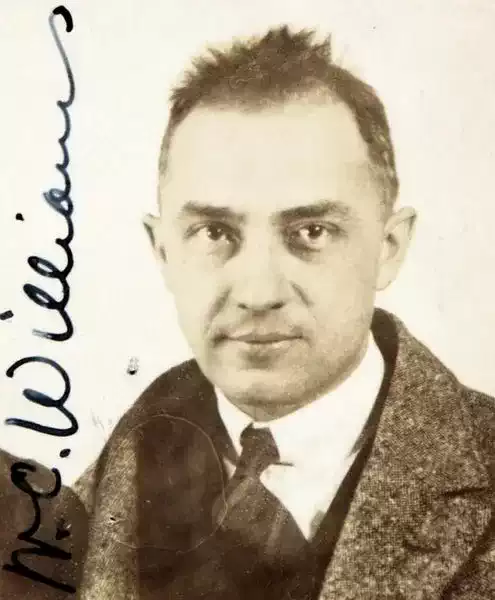
William Carlos Williams

William Carlos Williams

1883–1963 · lived 79 years US US

William Carlos Williams was an American poet, physician, and writer closely associated with the Modernist movement. His poetry is characterized by its focus on everyday American life, colloquial speech, and vivid imagery, often drawing inspiration from the ordinary objects and experiences of his surroundings. Williams championed the idea of a distinctly American poetry, free from European influences, and his work significantly impacted the development of Imagism and later poetic movements.

n. 1883-09-17, Rutherford · m. 1963-03-04, Rutherford

19,112 Views

Willow Poem

Willow Poem
It is a willow when summer is over,
a willow by the river
from which no leaf has fallen nor
bitten by the sun
turned orange or crimson.
The leaves cling and grow paler,
swing and grow paler
over the swirling waters of the river
as if loth to let go,
they are so cool, so drunk with
the swirl of the wind and of the river --
oblivious to winter,
the last to let go and fall
into the water and on the ground.
Read full poem
Bio

Identification and basic context

William Carlos Williams was an American poet, pediatrician, and writer. He was born in Rutherford, New Jersey, a place that would profoundly influence his work. Williams wrote primarily in English and was a key figure in the American Modernist movement. His life spanned periods of significant technological and social change in the United States, including the early days of automobiles, the World Wars, and the rise of mass media.

Childhood and education

Williams's childhood was marked by his dual heritage, with a white father from an English-speaking background and a mother of Puerto Rican descent. He spent his early years in Puerto Rico and then in New York City, where he attended public schools. He later studied at the University of Pennsylvania, where he met Ezra Pound and Hilda Doolittle (H.D.), who would become important literary figures. Williams pursued medical studies, eventually specializing in pediatrics, a profession that deeply informed his poetic vision by keeping him grounded in the realities of everyday life and human experience.

Literary trajectory

Williams's literary career began during his university years, where he became involved with the Imagist movement, though he later diverged from its more rigid tenets. His early collections of poetry, such as *The Tempers* (1913) and *Al Que Quiere!* (1917), began to establish his distinctive voice. He gained significant recognition for *Spring and All* (1923) and *The Great American Novel* (1920). His long poem *Paterson* (1946-1958) is considered his magnum opus, a sprawling, multi-part work that attempted to capture the essence of American life in the modern era. Throughout his life, he also wrote plays, essays, and a novel.

Works, style, and literary characteristics

Key works include *Spring and All*, *Paterson*, *Pictures from Brueghel and Other Poems*, and his autobiography, *Yes, Mrs. Williams*. Williams's dominant themes include the beauty and significance of the ordinary, the complexities of American identity, the relationship between art and life, and the specificities of the American landscape and language. His style is characterized by its use of colloquial American speech, its emphasis on clear, concrete imagery, and its rejection of traditional poetic forms. He advocated for "no ideas but in things," meaning poetry should arise directly from observed reality. His poetic voice is often direct, observant, and empathetic. Williams was a pioneer of free verse, developing his own "variable foot" measure, which sought to capture the natural rhythms of American speech. His innovations in form and language helped define a distinctly American poetic idiom.

Cultural and historical context

Williams was a contemporary of many key Modernist figures, including Ezra Pound, T.S. Eliot, and Marianne Moore. While he shared some Imagist principles with Pound and H.D., he often diverged from their more European-influenced aesthetics, championing a uniquely American voice. His career coincided with major historical events like World War I and II, the Great Depression, and the burgeoning civil rights movement, all of which, directly or indirectly, found their way into his observations of American life.

Personal life

Williams's life as a practicing pediatrician in his hometown of Rutherford, New Jersey, profoundly shaped his perspective. His family life, including his marriage to Flossie, and his relationships with his children, provided a grounding influence. His professional responsibilities often limited his ability to fully immerse himself in literary circles, but he maintained close friendships with many writers, including Pound, who acted as his early champion and correspondent. His commitment to his patients and his community was as central to his identity as his writing.

Recognition and reception

While Williams achieved a dedicated following among poets and critics during his lifetime, his broader recognition came later. He received critical acclaim for *Paterson* and was awarded the Pulitzer Prize for Poetry in 1963 for *Pictures from Brueghel and Other Poems*. His influence grew significantly in the post-war period, particularly with the rise of the Beat Generation poets, who saw him as a crucial precursor to their own experimental approaches to language and form.

Influences and legacy

Williams was influenced by the Imagists, Walt Whitman, and the everyday reality he encountered as a doctor. His legacy is immense; he is considered one of the most important American poets of the 20th century. His emphasis on American vernacular, concrete imagery, and the exploration of the local has had a profound impact on subsequent generations of poets, including the Beats, the Black Mountain poets, and many contemporary American writers. His championing of a poetry rooted in everyday experience continues to resonate.

Interpretation and critical analysis

Williams's poetry is often analyzed for its engagement with American identity, its representation of the working class and ordinary life, and its formal innovations. Critics explore the tension between his medical practice and his poetic practice, and how his observations of the human body and social conditions informed his verse. His commitment to the "local" as a source of universal truth is a recurring point of critical discussion.

Curiosities and lesser-known aspects

Williams's dual career as a poet and a pediatrician is perhaps his most striking characteristic. He often carried a notebook with him during his medical rounds, jotting down observations that would later find their way into his poems. His close correspondence with Ezra Pound was instrumental in his early career. He was known for his energetic and direct personality, much like his poetry.

Death and memory

William Carlos Williams died at his home in Rutherford, New Jersey. His death was a significant loss to American literature, but his work continued to be widely read, studied, and celebrated. His influence remains strong, and he is remembered as a poet who found profound beauty and meaning in the everyday world.

Poems

43

Portrait of a Lady

Portrait of a Lady
Your thighs are appletrees
whose blossoms touch the sky.
Which sky? The sky
where Watteau hung a lady's
slipper. Your knees
are a southern breeze -- or
a gust of snow. Agh! what
sort of man was Fragonard?
-- As if that answered
anything. -- Ah, yes. Below
the knees, since the tune
drops that way, it is
one of those white summer days,
the tall grass of your ankles
flickers upon the shore --
Which shore? --
the sand clings to my lips --
Which shore?
Agh, petals maybe. How
should I know?
Which shore? Which shore?
-- the petals from some hidden
appletree -- Which shore?
I said petals from an appletree.
338

Poem

Poem
As the cat
climbed over
the top of
the jamcloset
first the right
forefoot
carefully
then the hind
stepped down
into the pit of
the empty
flowerpot.
286

Peace on Earth

Peace on Earth
The Archer is wake!
The Swan is flying!
Gold against blue
An Arrow is lying.
There is hunting in heaven--
Sleep safe till tomorrow.
The Bears are abroad!
The Eagle is screaming!
Gold against blue
Their eyes are gleaming!
Sleep!
Sleep safe till tomorrow.
The Sisters lie
With their arms intertwining;
Gold against blue
Their hair is shining!
The Serpent writhes!
Orion is listening!
Gold against blue
His sword is glistening!
Sleep!
There is hunting in heaven--
Sleep safe till tomorrow.
413

Overture to a Dance of Locomotives

Overture to a Dance of Locomotives
Men with picked voices chant the names
of cities in a huge gallery: promises
that pull through descending stairways
to a deep rumbling.
The rubbing feet
of those coming to be carried quicken a
grey pavement into soft light that rocks
to and fro, under the domed ceiling,
across and across from pale
earthcolored walls of bare limestone.
Covertly the hands of a great clock
go round and round! Were they to
move quickly and at once the whole
secret would be out and the shuffling
of all ants be done forever.
A leaning pyramid of sunlight, narrowing
out at a high window, moves by the clock:
disaccordant hands straining out from
a center: inevitable postures infinitely
repeated--
two--twofour--twoeight!
Porters in red hats run on narrow platforms.
This way ma'am!
--important not to take
the wrong train!
Lights from the concrete
ceiling hang crooked but--
Poised horizontal
on glittering parallels the dingy cylinders
packed with a warm glow--inviting entry--
pull against the hour. But brakes can
hold a fixed posture till--
The whistle!
Not twoeight. Not twofour. Two!
Gliding windows. Colored cooks sweating
in a small kitchen. Taillights--
In time: twofour!
In time: twoeight!
--rivers are tunneled: trestles
cross oozy swampland: wheels repeating
the same gesture remain relatively
stationary: rails forever parallel
return on themselves infinitely.
The dance is sure.

545

Memory of April

Memory of April
You say love is this, love is that:
Poplar tassels, willow tendrils
the wind and the rain comb,
tinkle and drip, tinkle and drip--
branches drifting apart. Hagh!
Love has not even visited this country.
340

Nantucket

Nantucket
Flowers through the window
lavender and yellow
changed by white curtains –
Smell of cleanliness –
Sunshine of late afternoon –
On the glass tray
a glass pitcher, the tumbler
turned down, by which
a key is lying – And the
immaculate white bed
370

Love Song

Love Song
I lie here thinking of you:---
the stain of love
is upon the world!
Yellow, yellow, yellow
it eats into the leaves,
smears with saffron
the horned branched the lean
heavily
against a smooth purple sky!
There is no light
only a honey-thick stain
that drips from leaf to leaf
and limb to limb
spoiling the colors
of the whole worldyou
far off there under
the wine-red selvage of the west!
424

Light Hearted Author

Light Hearted Author
The birches are mad with green points
the wood's edge is burning with their green,
burning, seething--No, no, no.
The birches are opening their leaves one
by one. Their delicate leaves unfold cold
and separate, one by one. Slender tassels
hang swaying from the delicate branch tips--
Oh, I cannot say it. There is no word.
Black is split at once into flowers. In
every bog and ditch, flares of
small fire, white flowers!--Agh,
the birches are mad, mad with their green.
The world is gone, torn into shreds
with this blessing. What have I left undone
that I should have undertaken?
O my brother, you redfaced, living man
ignorant, stupid whose feet are upon
this same dirt that I touch--and eat.
We are alone in this terror, alone,
face to face on this road, you and I,
wrapped by this flame!
Let the polished plows stay idle,
their gloss already on the black soil.
But that face of yours--!
Answer me. I will clutch you. I
will hug you, grip you. I will poke my face
into your face and force you to see me.
Take me in your arms, tell me the commonest
thing that is in your mind to say,
say anything. I will understand you--!
It is the madness of the birch leaves opening
cold, one by one.
My rooms will receive me. But my rooms
are no longer sweet spaces where comfort
is ready to wait on me with its crumbs.
A darkness has brushed them. The mass
of yellow tulips in the bowl is shrunken.
Every familiar object is changed and dwarfed.
I am shaken, broken against a might
that splits comfort, blows apart
my careful partitions, crushes my house
and leaves me--with shrinking heart
and startled, empty eyes--peering out
into a cold world.
In the spring I would be drunk! In the spring
I would be drunk and lie forgetting all things.
Your face! Give me your face, Yang Kue Fei!
your hands, your lips to drink!
Give me your wrists to drink--


I drag you, I am drowned in you, you
overwhelm me! Drink!
Save me! The shad bush is in the edge
of the clearing. The yards in a fury
of lilac blossoms are driving me mad with terror.
Drink and lie forgetting the world.
And coldly the birch leaves are opening one by one.
Coldly I observe them and wait for the end.
And it ends.
370

Hunters in the Snow

Hunters in the Snow
The over-all picture is winter
icy mountains
in the background the return
from the hunt it is toward evening
from the left
sturdy hunters lead in
their pack the inn-sign
hanging from a
broken hinge is a stag a crucifix
between his antlers the cold
inn yard is
deserted but for a huge bonfire
that flares wind-driven tended by
women who cluster
about it to the right beyond
the hill is a pattern of skaters
Brueghel the painter
concerned with it all has chosen
a winter-struck bush for his
foreground to
complete the picture
471

January Morning

January Morning
I
I have discovered that most of
the beauties of travel are due to
the strange hours we keep to see them:
the domes of the Church of
the Paulist Fathers in Weehawken
against a smoky dawn -- the heart stirred --
are beautiful as Saint Peters
approached after years of anticipation.
II
Though the operation was postponed
I saw the tall probationers
in their tan uniforms
hurrying to breakfast!
III
-- and from basement entries
neatly coiffed, middle aged gentlemen
with orderly moustaches and
well-brushed coats
IV
-- and the sun, dipping into the avenues
streaking the tops of
the irregular red houselets,
and
the gay shadows drooping and drooping.
V
-- and a young horse with a green bed-quilt
on his withers shaking his head:
bared teeth and nozzle high in the air!
VI
--and a semicircle of dirt-colored men
about a fire bursting from an old
ash can,
VII
-- and the worn,
blue car rails (like the sky!)
gleaming among the cobbles!


VIII
-- and the rickety ferry-boat "Arden"!
What an object to be called "Arden"
among the great piers, -- on the
ever new river!
"Put me a Touchstone
at the wheel, white gulls, and we'll
follow the ghost of the Half Moon
to the North West Passage -- and through!
(at Albany!) for all that!"
IX
Exquisite brown waves -- long
circlets of silver moving over you!
enough with crumbling ice crusts among you!
The sky has come down to you,
lighter than tiny bubbles, face to
face with you!
His spirit is
a white gull with delicate pink feet
and a snowy breast for you to
hold to your lips delicately!
X
The young doctor is dancing with happiness
in the sparkling wind, alone
at the prow of the ferry! He notices
the curdy barnacles and broken ice crusts
left at the slip's base by the low tide
and thinks of summer and green
shell-crusted ledges among
the emerald eel-grass!
XI
Who knows the Palisades as I do
knows the river breaks east from them
above the city -- but they continue south
-- under the sky -- to bear a crest of
little peering houses that brighten
with dawn behind the moody
water-loving giants of Manhattan.
XII
Long yellow rushes bending
above the white snow patches;
purple and gold ribbon
of the distant wood:


what an angle
you make with each other as
you lie there in contemplation.
XIII
Work hard all your young days
and they'll find you too, some morning
staring up under
your chiffonier at its warped
bass-wood bottom and your soul --
out!
-- among the little sparrows
behind the shutter.
XIV
-- and the flapping flags are at
half-mast for the dead admiral.
XV
All this --
was for you, old woman.
I wanted to write a poem
that you would understand.
For what good is it to me
if you can't understand it?
But you got to try hard --
But --
Well, you know how
the young girls run giggling
on Park Avenue after dark
when they ought to be home in bed?
Well,
that's the way it is with me somehow.
489

Quotes

35

Videos

50

Comments (0)

Share
Log in to post a comment.

No comments yet. Be the first to comment.