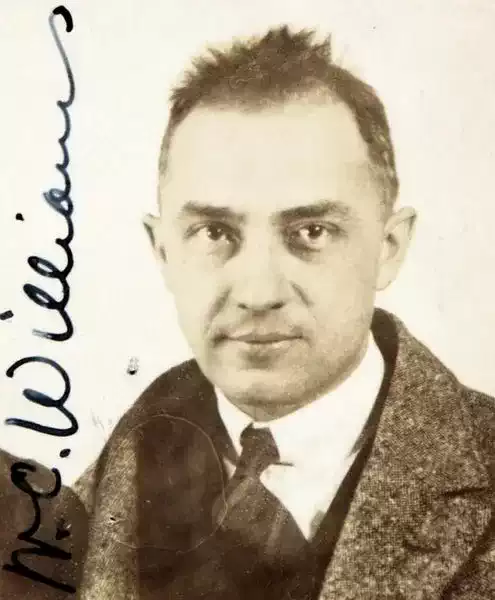
William Carlos Williams

William Carlos Williams

1883–1963 · lived 79 years US US

William Carlos Williams was an American poet, physician, and writer closely associated with the Modernist movement. His poetry is characterized by its focus on everyday American life, colloquial speech, and vivid imagery, often drawing inspiration from the ordinary objects and experiences of his surroundings. Williams championed the idea of a distinctly American poetry, free from European influences, and his work significantly impacted the development of Imagism and later poetic movements.

n. 1883-09-17, Rutherford · m. 1963-03-04, Rutherford

19,112 Views

Willow Poem

Willow Poem
It is a willow when summer is over,
a willow by the river
from which no leaf has fallen nor
bitten by the sun
turned orange or crimson.
The leaves cling and grow paler,
swing and grow paler
over the swirling waters of the river
as if loth to let go,
they are so cool, so drunk with
the swirl of the wind and of the river --
oblivious to winter,
the last to let go and fall
into the water and on the ground.
Read full poem
Bio

Identification and basic context

William Carlos Williams was an American poet, pediatrician, and writer. He was born in Rutherford, New Jersey, a place that would profoundly influence his work. Williams wrote primarily in English and was a key figure in the American Modernist movement. His life spanned periods of significant technological and social change in the United States, including the early days of automobiles, the World Wars, and the rise of mass media.

Childhood and education

Williams's childhood was marked by his dual heritage, with a white father from an English-speaking background and a mother of Puerto Rican descent. He spent his early years in Puerto Rico and then in New York City, where he attended public schools. He later studied at the University of Pennsylvania, where he met Ezra Pound and Hilda Doolittle (H.D.), who would become important literary figures. Williams pursued medical studies, eventually specializing in pediatrics, a profession that deeply informed his poetic vision by keeping him grounded in the realities of everyday life and human experience.

Literary trajectory

Williams's literary career began during his university years, where he became involved with the Imagist movement, though he later diverged from its more rigid tenets. His early collections of poetry, such as *The Tempers* (1913) and *Al Que Quiere!* (1917), began to establish his distinctive voice. He gained significant recognition for *Spring and All* (1923) and *The Great American Novel* (1920). His long poem *Paterson* (1946-1958) is considered his magnum opus, a sprawling, multi-part work that attempted to capture the essence of American life in the modern era. Throughout his life, he also wrote plays, essays, and a novel.

Works, style, and literary characteristics

Key works include *Spring and All*, *Paterson*, *Pictures from Brueghel and Other Poems*, and his autobiography, *Yes, Mrs. Williams*. Williams's dominant themes include the beauty and significance of the ordinary, the complexities of American identity, the relationship between art and life, and the specificities of the American landscape and language. His style is characterized by its use of colloquial American speech, its emphasis on clear, concrete imagery, and its rejection of traditional poetic forms. He advocated for "no ideas but in things," meaning poetry should arise directly from observed reality. His poetic voice is often direct, observant, and empathetic. Williams was a pioneer of free verse, developing his own "variable foot" measure, which sought to capture the natural rhythms of American speech. His innovations in form and language helped define a distinctly American poetic idiom.

Cultural and historical context

Williams was a contemporary of many key Modernist figures, including Ezra Pound, T.S. Eliot, and Marianne Moore. While he shared some Imagist principles with Pound and H.D., he often diverged from their more European-influenced aesthetics, championing a uniquely American voice. His career coincided with major historical events like World War I and II, the Great Depression, and the burgeoning civil rights movement, all of which, directly or indirectly, found their way into his observations of American life.

Personal life

Williams's life as a practicing pediatrician in his hometown of Rutherford, New Jersey, profoundly shaped his perspective. His family life, including his marriage to Flossie, and his relationships with his children, provided a grounding influence. His professional responsibilities often limited his ability to fully immerse himself in literary circles, but he maintained close friendships with many writers, including Pound, who acted as his early champion and correspondent. His commitment to his patients and his community was as central to his identity as his writing.

Recognition and reception

While Williams achieved a dedicated following among poets and critics during his lifetime, his broader recognition came later. He received critical acclaim for *Paterson* and was awarded the Pulitzer Prize for Poetry in 1963 for *Pictures from Brueghel and Other Poems*. His influence grew significantly in the post-war period, particularly with the rise of the Beat Generation poets, who saw him as a crucial precursor to their own experimental approaches to language and form.

Influences and legacy

Williams was influenced by the Imagists, Walt Whitman, and the everyday reality he encountered as a doctor. His legacy is immense; he is considered one of the most important American poets of the 20th century. His emphasis on American vernacular, concrete imagery, and the exploration of the local has had a profound impact on subsequent generations of poets, including the Beats, the Black Mountain poets, and many contemporary American writers. His championing of a poetry rooted in everyday experience continues to resonate.

Interpretation and critical analysis

Williams's poetry is often analyzed for its engagement with American identity, its representation of the working class and ordinary life, and its formal innovations. Critics explore the tension between his medical practice and his poetic practice, and how his observations of the human body and social conditions informed his verse. His commitment to the "local" as a source of universal truth is a recurring point of critical discussion.

Curiosities and lesser-known aspects

Williams's dual career as a poet and a pediatrician is perhaps his most striking characteristic. He often carried a notebook with him during his medical rounds, jotting down observations that would later find their way into his poems. His close correspondence with Ezra Pound was instrumental in his early career. He was known for his energetic and direct personality, much like his poetry.

Death and memory

William Carlos Williams died at his home in Rutherford, New Jersey. His death was a significant loss to American literature, but his work continued to be widely read, studied, and celebrated. His influence remains strong, and he is remembered as a poet who found profound beauty and meaning in the everyday world.

Poems

43

The Poor

The Poor
By constantly tormenting them
with reminders of the lice in
their children's hair, the
School Physician first
brought their hatred down on him.
But by this familiarity
they grew used to him, and so,
at last,
took him for their friend and adviser.
470

The Lonely Street

The Lonely Street
School is over. It is too hot
to walk at ease. At ease
in light frocks they walk the streets
to while the time away.
They have grown tall. They hold
pink flames in their right hands.
In white from head to foot,
with sidelong, idle look--
in yellow, floating stuff,
black sash and stockings--
touching their avid mouths
with pink sugar on a stick--
like a carnation each holds in her hand--
they mount the lonely street.
417

The Great Figure

The Great Figure
Among the rain
and lights
I saw the figure
in gold
on a red
firetruck
moving
tense
unheeded
to gong clangs
siren howls
and wheels rumbling
through the dark city.
287

The Last Words of My English Grandmother

The Last Words of My English Grandmother
There were some dirty plates
and a glass of milk
beside her on a small table
near the rank, disheveled bed--
Wrinkled and nearly blind
she lay and snored
rousing with anger in her tones
to cry for food,
Gimme something to eat--
They're starving me--
I'm all right--I won't go
to the hospital.No, no, no
Give me something to eat!
Let me take you
to the hospital, I said
and after you are well
you can do as you please.
She smiled, Yes
you do what you please first
then I can do what I please--
Oh, oh, oh! she cried
as the ambulance men lifted
her to the stretcher--
Is this what you call
making me comfortable?
By now her mind was clear--
Oh you think you're smart
you young people,
she said, but I'll tell you
you don't know anything.
Then we started.
On the way
we passed a long row
of elms. She looked at them
awhile out of
the ambulance window and said,
What are all those
fuzzy looking things out there?
Trees?Well, I'm tired
of them and rolled her head away.
702

The Dark Day

The Dark Day
A three-day-long rain from the east--
an terminable talking, talking
of no consequence--patter, patter, patter.
Hand in hand little winds
blow the thin streams aslant.
Warm. Distance cut off. Seclusion.
A few passers-by, drawn in upon themselves,
hurry from one place to another.
Winds of the white poppy! there is no escape!--
An interminable talking, talking,
talking . . .it has happened before.
Backward, backward, backward.
473

The Disputants

The Disputants
Upon the table in their bowl
in violent disarray
of yellow sprays, green spikes
of leaves, red pointed petals
and curled heads of blue
and white among the litter
of the forks and crumbs and plates
the flowers remain composed.
Coolly their colloquy continues
above the coffee and loud talk
grown frail as vaudeville.
380

The Cold Night

The Cold Night
It is cold. The white moon
is up among her scattered stars--
like the bare thighs of
the Police Sergeant's wife--among
her five children . . .
No answer. Pale shadows lie upon
the frosted grass. One answer:
It is midnight, it is still
and it is cold . . . !
White thights of the sky! a
new answer out of the depths of
my male belly: In April . . .
In April I shall see again--In April!
the round and perfects thighs
of the Police Sergeant's wife
perfect still after many babies.
Oya!
302

The Artist

The Artist
Mr T.
bareheaded
in a soiled undershirt
his hair standing out
on all sides
stood on his toes
heels together
arms gracefully
for the moment
curled above his head.
Then he whirled about
bounded
into the air
and with an entrechat
perfectly achieved
completed the figure.
My mother
taken by surprise
where she sat
in her invalid's chair
was left speechless.
Bravo! she cried at last
and clapped her hands.
The man's wife
came from the kitchen:
What goes on here? she said.
But the show was over.
484

Queen Anne's Lace

Queen Anne's Lace
Her body is not so white as
anemone petals nor so smooth--nor
so remote a thing. It is a field
of the wild carrot taking
thefield by force; the grass
does not raise above it.
Here is no question of whiteness,
white as can be, with a purple mole
at the center of each flower.
Each flower is a hand's span
of her whiteness. Wherever
his hand has lain there is
a tiny purple blossom under his touch
to which the fibres of her being
stem one by one, each to its end,
until the whole field is a
white desire, empty, a single stem,
a cluster, flower by flower,
a pious wish to whiteness gone over--
or nothing.
492

Smell

Smell
Oh strong-ridged and deeply hollowed
nose of mine! what will you not be smelling?
What tactless asses we are, you and I, boney nose,
always indiscriminate, always unashamed,
and now it is the souring flowers of the bedreggled
poplars: a festering pulp on the wet earth
beneath them. With what deep thirst
we quicken our desires
to that rank odor of a passing springtime!
Can you not be decent? Can you not reserve your ardors
for something less unlovely? What girl will care
for us, do you think, if we continue in these ways?
Must you taste everything? Must you know everything?
Must you have a part in everything?
423

Quotes

35

Videos

50

Comments (0)

Share
Log in to post a comment.

No comments yet. Be the first to comment.