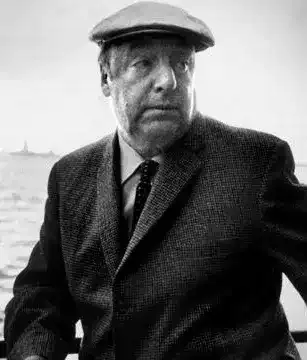
Pablo Neruda

Pablo Neruda

1904–1973 · lived 69 years CL CL

Pablo Neruda was a Chilean poet, diplomat, and politician. He is widely regarded as one of the most influential poets of the 20th century, celebrated for his lyrical and evocative verse, which often explored themes of love, nature, politics, and everyday life. Neruda's prolific output and diverse thematic concerns earned him international acclaim, culminating in the Nobel Prize in Literature in 1971. His work is characterized by its passionate imagery, sensuous language, and profound connection to the landscapes and people of Latin America.

n. 1904-07-12, Parral · m. 1973-09-23, Santiago

48,550 Views

Your Laughter

Your Laughter

Take bread away from me, if you wish,
take air away, but
do not take from me your laughter.


Do not take away the rose,
the lance flower that you pluck,
the water that suddenly
bursts forth in joy,
the sudden wave
of silver born in you.


My struggle is harsh and I come back
with eyes tired
at times from having seen
the unchanging earth,
but when your laughter enters
it rises to the sky seeking me
and it opens for me all
the doors of life.


My love, in the darkest
hour your laughter
opens, and if suddenly
you see my blood staining
the stones of the street,
laugh, because your laughter
will be for my hands
like a fresh sword.


Next to the sea in the autumn,
your laughter must raise
its foamy cascade,
and in the spring, love,
I want your laughter like
the flower I was waiting for,
the blue flower, the rose
of my echoing country.


Laugh at the night,
at the day, at the moon,
laugh at the twisted
streets of the island,
laugh at this clumsy
boy who loves you,
but when I open
my eyes and close them,
when my steps go,
when my steps return,
deny me bread, air,
light, spring,
but never your laughter
for I would die.
Read full poem
Bio

Identification and basic context

Pablo Neruda, born Ricardo Eliécer Neftalí Reyes Basoalto, was a renowned Chilean poet, diplomat, and politician. He is considered one of the most important literary figures of the 20th century and a significant voice for social justice in Latin America. Neruda's work is characterized by its passionate, often surreal imagery, its deep connection to nature, and its engagement with political and social issues. He wrote in Spanish, and his poetry has been translated into numerous languages.

Childhood and education

Neruda was born in Parral, Chile. His mother died shortly after his birth, and he was raised by his father and stepmother in Temuco. He showed an early aptitude for literature, publishing his first poems at the age of 13. He studied French at the Temuco Normal School for Men and later moved to Santiago to study at the University of Chile, although his primary focus remained his literary pursuits. His early life in the Chilean landscape, with its forests, rivers, and the proximity to the ocean, profoundly shaped his poetic sensibility.

Literary trajectory

Neruda's literary career began in his youth, and he quickly gained recognition. He published his first book, "Crepusculario" (Twilight), in 1923. However, it was "Veinte poemas de amor y una canción desesperada" (Twenty Love Poems and a Song of Despair, 1924) that brought him widespread fame. He served as a diplomat for Chile in various countries, including Burma, Ceylon, Java, Argentina, Spain, Mexico, and France. These experiences significantly influenced his writing, broadening his perspective and introducing him to new political and cultural landscapes. His poetry evolved from early romanticism and surrealism to a more politically engaged and socially conscious style.

Works, style, and literary characteristics

Neruda's vast body of work includes "Residencia en la tierra" (Residence on Earth), "Canto general" (General Song), and "Odas elementales" (Elemental Odes). His style is marked by its sensuousness, its rich metaphors, and its profound connection to the natural world. He explored themes of love, death, time, memory, political struggle, and the beauty of everyday objects and natural phenomena. His language is often direct yet deeply evocative, capable of capturing both the grand sweep of history and the intimate details of human experience. He experimented with various forms, from traditional verse to free verse, and his "Elemental Odes" are known for their concise, accessible celebration of ordinary things.

Cultural and historical context

Neruda lived through a turbulent period in Latin American history, marked by political instability, social upheaval, and the rise of authoritarian regimes. As a member of the Communist Party, his political activism led to periods of exile and persecution. His poetry often reflected these historical realities, serving as a voice for the oppressed and a testament to the struggles of the common people. He was a contemporary of other major Latin American writers and intellectuals, contributing to the vibrant literary and political discourse of the region.

Personal life

Neruda had three marriages and several significant relationships that influenced his poetry. His political activities often led to periods of separation from his loved ones. He was a dedicated communist, and his political beliefs deeply informed his life and work, leading him to serve as a senator and a presidential candidate before going into exile. He was known for his deep love of Chile, its landscapes, and its people, which he sought to express through his art and his political actions.

Recognition and reception

Neruda received numerous awards and honors throughout his career, most notably the Nobel Prize in Literature in 1971 for "his poetic works which, with the action of an elemental force, have given a continent its destiny and dreams." He is one of the most widely read poets in the world, and his work continues to resonate with readers across cultures and generations. His reception has been overwhelmingly positive, celebrating his lyrical genius and his unwavering commitment to humanity.

Influences and legacy

Neruda was influenced by poets like Walt Whitman and the European surrealists, but he forged a unique voice that became emblematic of Latin American poetry. He, in turn, influenced countless poets throughout the world with his passionate style, his commitment to social justice, and his ability to find poetry in the ordinary. His "Canto General" is considered a monumental epic of the Americas. Neruda's legacy is that of a poet who captured the soul of a continent and used his art as a powerful tool for social and political change.

Interpretation and critical analysis

Neruda's poetry is frequently analyzed for its exploration of identity, belonging, and the relationship between the individual and the collective. His surrealist leanings in earlier works are often contrasted with the direct political engagement of his later poetry. Critics have examined his role as a national poet and a voice for the marginalized, exploring the ways in which his work both reflects and shapes Latin American consciousness.

Curiosities and lesser-known aspects

Neruda was an avid collector of unusual objects, including various types of shells, ships in bottles, and typewriters, which he displayed in his homes. His houses, particularly La Chascona in Santiago, Isla Negra, and El Cañete in Buenos Aires, are now museums dedicated to his life and work. He was also known for his immense generosity and his support for other artists and writers.

Death and memory

Pablo Neruda died in 1973, shortly after the military coup in Chile that overthrew Salvador Allende's government. While officially attributed to cancer, there have been ongoing investigations and debates surrounding the possibility of foul play. His death was a profound loss for Chile and the literary world. His works continue to be widely read and celebrated, and his memory remains a potent symbol of artistic expression and political conviction in Latin America and beyond.

Poems

72

Sonnet XXXIV

Sonnet XXXIV

You are the daughter of the sea, oregano's first cousin.
Swimmer, your body is pure as the water;
cook, your blood is quick as the soil.
Everything you do is full of flowers, rich with the earth.


Your eyes go out toward the water, and the waves rise;
your hands go out to the earth and the seeds swell;
you know the deep essence of water and the earth,
conjoined in you like a formula for clay.


Naiad: cut your body into turquoise pieces,
they will bloom resurrected in the kitchen.
This is how you become everything that lives.


And so at last, you sleep, in the circle of my arms
that push back the shadows so that you can restvegetables,
seaweed, herbs: the foam of your dreams.


Translated by Stephen Tapscott
676

Sonnet XXV

Sonnet XXV

Before I loved you, love, nothing was my own:
I wavered through the streets, among
Objects:
Nothing mattered or had a name:
The world was made of air, which waited.


I knew rooms full of ashes,
Tunnels where the moon lived,
Rough warehouses that growled 'get lost',
Questions that insisted in the sand.


Everything was empty, dead, mute,
Fallen abandoned, and decayed:
Inconceivably alien, it all


Belonged to someone else - to no one:
Till your beauty and your poverty
Filled the autumn plentiful with gifts.
602

Sonnet XVII

Sonnet XVII

I do not love you as if you were salt-rose, or topaz,
or the arrow of carnations the fire shoots off.
I love you as certain dark things are to be loved,
in secret, between the shadow and the soul.

I love you as the plant that never blooms
but carries in itself the light of hidden flowers;
thanks to your love a certain solid fragrance,
risen from the earth, lives darkly in my body.

I love you without knowing how, or when, or from where.
I love you straightforwardly, without complexities or pride;
so I love you because I know no other way

than this: where I does not exist, nor you,
so close that your hand on my chest is my hand,
so close that your eyes close as I fall asleep.
818

Sonnet XIII:The light that rises from your feet to your hair

Sonnet XIII:The light that rises from your feet to your hair

The light that rises from your feet to your hair,
the strength enfolding your delicate form,
are not mother of pearl, not chilly silver:
you are made of bread, a bread the fire adores.


The grain grew high in its harvest of you,
in good time the flour swelled;
as the dough rose, doubling your breasts,
my love was the coal waiting ready in the earth.


Oh, bread your forehead, your legs, your mouth,
bread I devour, born with the morning light,
my love, beacon-flag of the bakeries:


fire taugh you a lesson of the blood;
you learned your holiness from flour,
from bread your language and aroma.
549

Sonnet XCV:Who ever desired each other as we do

Sonnet XCV:Who ever desired each other as we do

Who ever desired each other as we do? Let us look
for the ancient ashes of hearts that burned,
and let our kisses touch there, one by one,
till the flower, disembodied, rises again.


Let us love that Desire that consumed its own fruit
and went down, aspect and power, into the earth:
We are its continuing light,
its indestructible, fragile seed
450

Sonnet VIII

Sonnet VIII

If your eyes were not the color of the moon,
of a day full [here, interrupted by the baby waking -- continued about 26
hours later ]
of a day full of clay, and work, and fire,
if even held-in you did not move in agile grace like the air,
if you were not an amber week,


not the yellow moment
when autumn climbs up through the vines;
if you were not that bread the fragrant moon
kneads, sprinkling its flour across the sky,


oh, my dearest, I could not love you so!
But when I hold you I hold everything that is -sand,
time, the tree of the rain,


everything is alive so that I can be alive:
without moving I can see it all:
in your life I see everything that lives.
592

Sonnet LXVI: I Do Not Love You Except Because I Love You

Sonnet LXVI: I Do Not Love You Except Because I Love You

I do not love you except because I love you;
I go from loving to not loving you,
From waiting to not waiting for you
My heart moves from cold to fire.


I love you only because it's you the one I love;
I hate you deeply, and hating you
Bend to you, and the measure of my changing love for you
Is that I do not see you but love you blindly.


Maybe January light will consume
My heart with its cruel
Ray, stealing my key to true calm.


In this part of the story I am the one who
Dies, the only one, and I will die of love because I love you,
Because I love you, Love, in fire and blood.
830

Sonnet LXXXI

Sonnet LXXXI

And now you're mine. Rest with your dream in my dream.
Love and pain and work should all sleep, now.
The night turns on its invisible wheels,
and you are pure beside me as a sleeping amber.


No one else, Love, will sleep in my dreams. You will go,
we will go together, over the waters of time.
No one else will travel through the shadows with me,
only you, evergreen, ever sun, ever moon.


Your hands have already opened their delicate fists
and let their soft drifting signs drop away; your eyes closed like two gray
wings, and I move


after, following the folding water you carry, that carries
me away. The night, the world, the wind spin out their destiny.
Without you, I am your dream, only that, and that is all.
654

Soneto XVII

Soneto XVII

No te amo como si fueras rosa de sal, topacio

o flecha de claveles que propagan el fuego:
te amo como se aman ciertas cosas oscuras,
secretamente, entre la sombra y el alma.
Te amo como la planta que no florece y lleva
dentro de sí, escondida, la luz de aquellas flores,
y gracias a tu amor vive oscuro en mi cuerpo
el apretado aroma que ascendió de la tierra.

Te amo sin saber cómo, ni cuándo, ni de dónde,
te amo directamente sin problemas ni orgullo:
así te amo porque no sé amar de otra manera,

sino así de este modo en que no soy ni eres,
tan cerca que tu mano sobre mi pecho es mía,
tan cerca que se cierran tus ojos con mi sueño.
777

Sonnet IX: There where the waves shatter

Sonnet IX: There where the waves shatter

There where the waves shatter on the restless rocks
the clear light bursts and enacts its rose,
and the sea-circle shrinks to a cluster of buds,
to one drop of blue salt, falling.


O bright magnolia bursting in the foam,
magnetic transient whose death blooms
and vanishes--being, nothingness--forever:
broken salt, dazzling lurch of the sea.


You & I, Love, together we ratify the silence,
while the sea destroys its perpetual statues,
collapses its towers of wild speed and whiteness:


because in the weavings of those invisible fabrics,
galloping water, incessant sand,
we make the only permanent tenderness.
561

Quotes

18

Videos

50

Comments (0)

Share
Log in to post a comment.

No comments yet. Be the first to comment.